Pipe Relining vs Pipe Replacement in Blacktown: Disruption Compared
| Quick answer: For most Blacktown homes, pipe relining is the far less disruptive option. Relining repairs the damaged pipe from the inside using existing access points, so in most cases there is no trench across the yard, no cut driveway and no landscaping to rebuild, and many residential sections can be back in service the same day. Pipe replacement means excavating along the pipe run, which usually brings machinery onto the property, takes longer, and leaves you with reinstatement work afterwards. Replacement is still the right answer when a drain has collapsed, sagged into a belly, or lost so much wall thickness that there is nothing solid left to line. |
What you will find in this guide
- What pipe relining actually involves
- What pipe replacement looks like on a Blacktown property
- Disruption compared, side by side
- Pipe relining vs pipe replacement in Blacktown: how the choice is made
- When replacement is the only honest answer
- The disruption most people forget to budget for
- Key takeaways
- Frequently asked questions
You have had the camera down the drain, and now there is a decision on the table. One plumber wants to reline. Another wants to dig. The quotes look different, the timelines look different, and nobody has really explained what either job will do to your Saturday, your driveway or your one working bathroom.
That is the part homeowners actually care about. When people compare pipe relining vs pipe replacement in Blacktown, the question underneath is rarely about resin chemistry or trench depth. It is: how long will my house be a worksite, and what will my yard look like when it is over?
This guide answers that directly. It covers what each method physically does to your property, where the disruption really comes from, and the specific situations where digging genuinely is the better call, even though it costs you more in mess.
What pipe relining actually involves
Pipe relining, sometimes called cured in place pipe or CIPP, rebuilds a damaged pipe from the inside. Rather than removing the old pipe, a resin saturated liner is pulled or inverted into position through an existing opening, inflated so it presses tight against the original pipe wall, then cured until it hardens into a new pipe within the old one. The result is a continuous, jointless internal wall that seals the cracks and gaps the old pipe had developed.
The practical consequence is that the work happens through access points that already exist. An inspection opening, a boundary shaft, a disconnected gully or a removed toilet pan is usually enough. If you are dealing with recurring blockages and want to understand the diagnostic step first, our approach to blocked drains and drainage problems starts with the same camera inspection that determines whether relining is even possible.
What a relining day typically looks like
- A CCTV inspection to confirm the pipe’s condition, then a clean of the line, often with a high pressure water jetter, so the liner can bond properly.
- Root cutting or descaling if the pipe has intrusion or heavy buildup.
- The liner is prepared, installed, inflated and cured.
- Junctions are reinstated, and a final camera pass confirms the finished result.
Water is usually off, or at least drainage is unavailable, for part of that process. That is real disruption, and it is worth planning around. But it is a matter of hours in a typical residential section rather than days, and when the crew leaves, the surface of your property is generally exactly as they found it.
| Still working out what is wrong? Before anyone quotes you on relining or replacement, you should know what the camera actually shows. Have a look at how pipe relining works at Local Blacktown Plumber, and what a proper drain inspection covers. |
What pipe replacement looks like on a Blacktown property
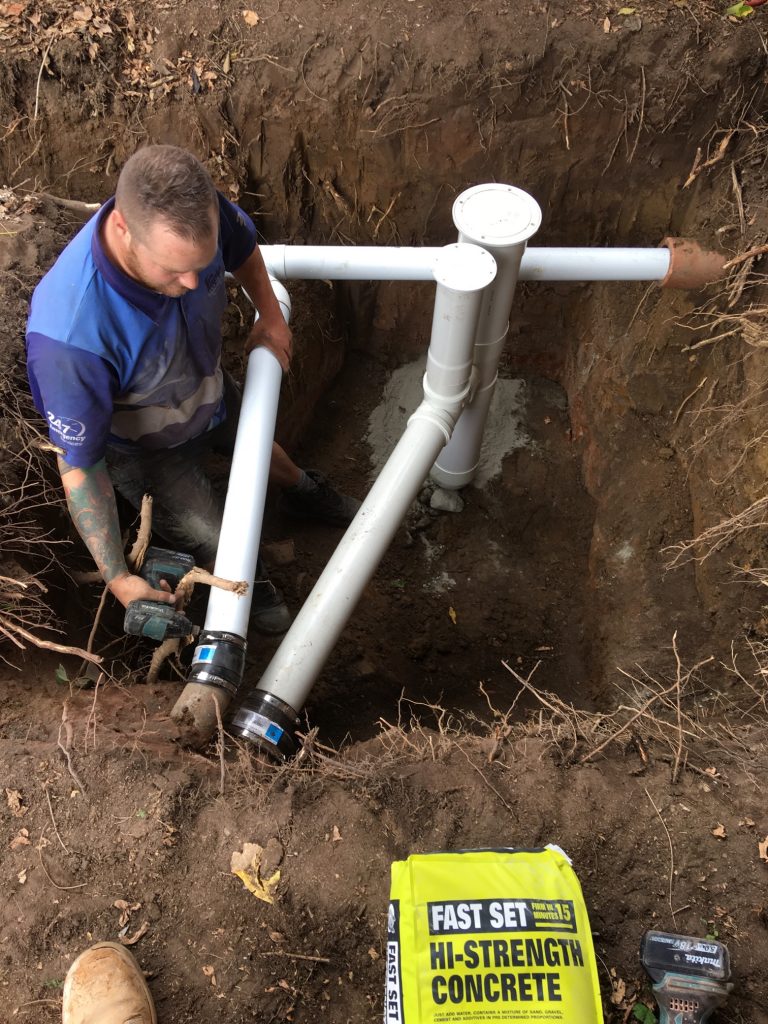
Replacement, sometimes called open cut or dig and lay, does what it sounds like. The crew excavates down to the damaged section, removes the old pipe, lays new pipe with correct fall, backfills, compacts and then reinstates the surface.
On a typical Western Sydney block, that pipe does not run helpfully down the middle of a bare lawn. It runs under a concrete path, along a side passage barely wide enough for a wheelbarrow, past the clothesline, under a paved entertaining area, and out to the boundary. The excavation follows the pipe, not your landscaping.
Blacktown adds a few local wrinkles. A lot of housing stock across the area went up when clay and earthenware drainage was standard, so the pipes now failing are often the original ones. Reactive clay soils across much of Western Sydney shift with wet and dry cycles, which is hard on rigid old pipe joints. And the mature street and backyard trees that make these suburbs pleasant to live in are relentless about sending roots toward the moisture leaking out of a cracked sewer line.
Where the time actually goes
The digging itself is often not the longest part. Access is. Getting a machine into a backyard can mean removing a fence panel. Where a machine will not fit, the trench is dug by hand, which is slower. Excavated soil has to go somewhere, usually onto a tarp on your lawn or into a truck. Then, once the new pipe is laid and inspected, the trench is backfilled and compacted properly, because a poorly compacted trench sinks later and takes your new path with it.
None of that makes replacement a bad method. It is the right method more often than the relining industry likes to admit. It is simply a bigger event on your property.
Disruption compared, side by side
| Factor | Pipe relining | Pipe replacement |
|---|---|---|
| Excavation | Usually none, or a small access pit | Trench along the length of the affected pipe run |
| Typical time on site | Often completed within a day for a residential section | Commonly multiple days, depending on length, depth and access |
| Impact on driveways, paths and paving | Generally left intact | Cut and removed where the pipe runs beneath |
| Impact on lawn and garden | Minimal | Significant along the trench line, including plants and turf |
| Machinery and noise | Jetter and curing equipment, moderate and short lived | Excavator or jackhammer, heavier and sustained |
| Reinstatement afterwards | Little to none | Concreting, paving, turf and landscaping to restore |
| Water and drainage downtime | Hours in most cases | Can extend across the works, sometimes with temporary arrangements |
| Effect on mature trees | Roots are cut back inside the pipe, the tree stays | Trenching near the root zone can damage or require removal of the tree |
That last row matters more than people expect. A large established tree is worth real money and decades of growth, and trenching through its root plate can compromise it even if it survives the job.
Pipe relining vs pipe replacement in Blacktown: how the choice is made
A good plumber does not decide this from the kerb. The choice comes out of a camera inspection, and it turns on the condition of the host pipe.
Relining tends to be well suited to pipes that are cracked, fractured, leaking at joints or invaded by roots, but still structurally present and holding their shape and fall. It is also the natural choice where the pipe runs under something you would rather not demolish, such as a driveway, a slab, a retaining wall or a well established garden. And it is often the pragmatic answer for a shared or boundary line where digging would spill onto a neighbour’s property.
Relining also pairs sensibly with other targeted repairs. A single failed section under the house may reline while a separate issue, such as a burst pipe closer to the surface, is dealt with conventionally. The two approaches are not rivals so much as different tools.
Where the picture is unclear, accurate location work does more to keep costs and mess down than any other single step. Non invasive leak detection and pipe location can narrow a suspected fault to a specific length of pipe, which is the difference between a targeted repair and a speculative trench across the yard.
| Comparing quotes? Ask each plumber for the camera footage and a plain explanation of why they recommend their method. If you want a second opinion on a report you have already been given, the team at Local Blacktown Plumber is happy to walk you through what the footage is showing before you commit to anything. |
When replacement is the only honest answer

Relining has genuine limits, and a plumber who says it can solve everything is selling rather than diagnosing. Replacement is generally the correct call when:
- The pipe has collapsed. A liner needs a host pipe to form against. Where a section has caved in, there is nothing left to line.
- There is a belly or sag in the line. Relining rebuilds the pipe wall, it does not correct fall. A section that has dropped and holds water will keep holding water afterwards, so the ground under it has to be corrected.
- The pipe is badly deformed or has lost too much wall. Heavily degraded earthenware or severely corroded metal may not be a viable host.
- The layout itself is the problem. Undersized pipe, an unworkable junction or a run laid to the wrong grade needs rebuilding, not resurfacing.
- Repeated failures across the whole run. When a line is failing everywhere rather than at a few identifiable points, replacing it can be the more sensible long term decision.
Where the failure is limited and the surrounding pipe is sound, ongoing preventative maintenance plumbing can extend the life of what you already have and delay the bigger job considerably.
The disruption most people forget to budget for
When homeowners compare quotes, they compare the plumbing figure. The disruption cost sits outside it.
Reinstatement is the big one. If a trench crosses your driveway, the excavation quote may not include recutting and repouring concrete to match. If it crosses the lawn, turf and topsoil are usually yours to sort out. Paving relaid over a settled trench often needs lifting and redoing later. These are real costs and real weekends, and they are the reason a cheaper looking excavation quote sometimes ends up being the more expensive project.
Then there is living through it. Household drainage is not usable while the line is open. Depending on the layout, that can mean a household without a working toilet for part of the job, which is a genuine consideration for families, shift workers and anyone at home during the day. If you are already dealing with a toilet that is backing up or draining slowly, it is worth raising the downtime question with your plumber before work starts rather than after.
Access and neighbours matter too. Machinery over a shared driveway, spoil stored on a narrow side passage, and work near a boundary line all need conversations in advance. Depending on where the pipe sits and whose asset it connects to, work on wastewater lines may involve requirements from the water authority as well as licensed plumbing and drainage work under NSW rules, so ask your plumber what approvals apply to your specific job.
Similar thinking applies on the supply side of the system. Deteriorating water service lines raise the same dig or repair question, and our fresh water supply work follows the same principle of confirming the fault properly before choosing the method.
Key takeaways
- Relining is almost always the less disruptive option, because it works through existing access points instead of a trench.
- Replacement is more invasive, but it is the correct method for collapsed pipe, sagging fall, or a line that is failing along its whole length.
- The camera inspection, not the quote, decides which method suits your property.
- Compare total project impact, including reinstatement of driveways, paving and landscaping, rather than the plumbing figure alone.
- Mature trees, shared driveways and boundary lines often tip the decision toward relining for practical reasons rather than technical ones.
| Get a straight answer on your pipe. If you are in Blacktown or the surrounding suburbs and you need to know whether your drain can be relined or has to be replaced, call Local Blacktown Plumber on (02) 9158 3589. We will inspect the line, show you what the camera sees, and give you an honest recommendation with the disruption spelled out before any work begins. |
Frequently asked questions
Is pipe relining as strong as a new pipe?
A properly installed cured liner forms a structural, jointless pipe inside the old one and is designed to carry the load of the original. Because it has no joints along the relined section, it removes the weak points where roots typically enter. The critical factor is installation quality, so ask about the products used and the warranty offered on the finished work.
Can every pipe in a Blacktown home be relined?
No. Relining needs a host pipe that is still holding its shape and its fall. Collapsed sections, pipes with a belly that holds water, and severely deformed lines generally have to be excavated and replaced. A CCTV inspection is what determines this, which is why any plumber quoting relining sight unseen should be treated with caution.
How long will my drainage be out of action?
For a typical residential relining job, you should plan for the drains to be unavailable for part of a working day, though this depends on the length of the line and the curing method used. Replacement usually means a longer period of disruption spread across the days the trench is open. Ask for a specific estimate for your property before booking.
Will relining fix a blocked drain caused by tree roots?
It addresses the cause rather than just the symptom. Roots enter through cracks and open joints, so clearing the blockage alone leaves the entry point open and the roots usually return. Cutting the roots out and then relining seals those entry points, which is why relining is often recommended for recurring root related blockages in older Blacktown drainage.
Do I need approval for pipe replacement in Blacktown?
Plumbing and drainage work in New South Wales must be carried out by an appropriately licensed plumber or drainer, and work that affects sewer connections can involve additional requirements from the water authority. What applies depends on the location and depth of the pipe and what it connects to, so confirm the approvals with your plumber before excavation is scheduled.
Which option is better value overall?
It depends on the pipe and what sits above it. Relining often looks better once reinstatement of driveways, paving and landscaping is counted, particularly where the line runs under hard surfaces. Where the pipe has collapsed or lost its fall, replacement is the option that actually solves the problem, and a liner would be money spent on a fault that remains