Pipe Relining vs Pipe Replacement in Blacktown: Which Suits Your Pipes?
| Quick answer: The choice between pipe relining vs pipe replacement in Blacktown comes down to the condition of the existing pipe and what sits above it. Relining pulls a resin liner through the old pipe and cures it in place, forming a new pipe inside the old one, so it suits drains that are cracked, root-damaged or leaking but still structurally continuous. Replacement means excavating and laying new pipe, and it becomes the honest answer when a line has collapsed, sagged badly, changed grade or been crushed. A CCTV drain inspection is the only reliable way to tell the two situations apart. Local Blacktown Plumber can inspect the line and explain what your options actually are on 02 9158 3589. |
What this article covers
- What pipe relining actually involves
- What pipe replacement involves
- Pipe relining vs pipe replacement in Blacktown, side by side
- When relining is the better fit
- When replacement is the only honest answer
- Why Blacktown ground makes this decision so common
- How the decision actually gets made
- Key takeaways
- Frequently asked questions
Most people meet this decision at the worst possible moment. The drain has backed up for the third time in a year, a camera has gone down the line, and there is now a screen showing something unpleasant: a crack with roots pushing through, or a section of pipe gone out of shape. Then comes the question. Do we line it, or dig it up?
It deserves a real answer rather than a sales pitch. Pipe relining vs pipe replacement in Blacktown is not a matter of one method being modern and the other outdated. They solve different problems. A liner is a repair to a pipe that still has a usable shape. Replacement is what you do when the pipe no longer has one. Get that distinction right and the rest of the decision becomes much simpler.
Here is how each method works, what each is genuinely good at, and the local conditions that push Blacktown properties towards one or the other.
What pipe relining actually involves
Relining is a no-dig repair, sometimes called cured-in-place pipe lining. Rather than removing the damaged pipe, the plumber creates a new pipe inside it.
The drain is cleared first, because a liner cannot be installed through a blockage. That normally means high pressure water jetting or mechanical cutting to strip roots, grease and scale back to bare pipe wall. Once the line is clean, a camera survey records the condition, the junctions and the exact position of the damage. A liner is then cut to size, saturated with resin, and pulled or inverted into position, where an inflatable bladder presses it tight against the old pipe wall while the resin cures. What remains is a smooth, jointless pipe bonded inside the original one, with junctions reopened by a cutter so branch lines still connect.
The appeal is obvious. Your driveway, your paving, your lawn and your mature trees stay where they are, because the work usually happens through existing access points rather than a trench across the yard. Because the new liner has no joints along its length, the pathway that roots normally exploit is gone. Manufacturers generally quote design lives measured in decades, though the real determinant is installation quality and the state of the host pipe.
That makes relining particularly good at awkward geography. Pipes running under a slab, a driveway, a boundary or a paved entertaining area are exactly the ones where excavation gets expensive, and exactly where a liner earns its keep.
| Not sure what is actually happening in your line? Recurring blockages, gurgling drains and slow-emptying fixtures all point somewhere, and the pattern usually narrows it down before anyone lifts a shovel. Our guide to when a drain snake, jetting or relining applies is a good place to start reading. |
What pipe replacement involves
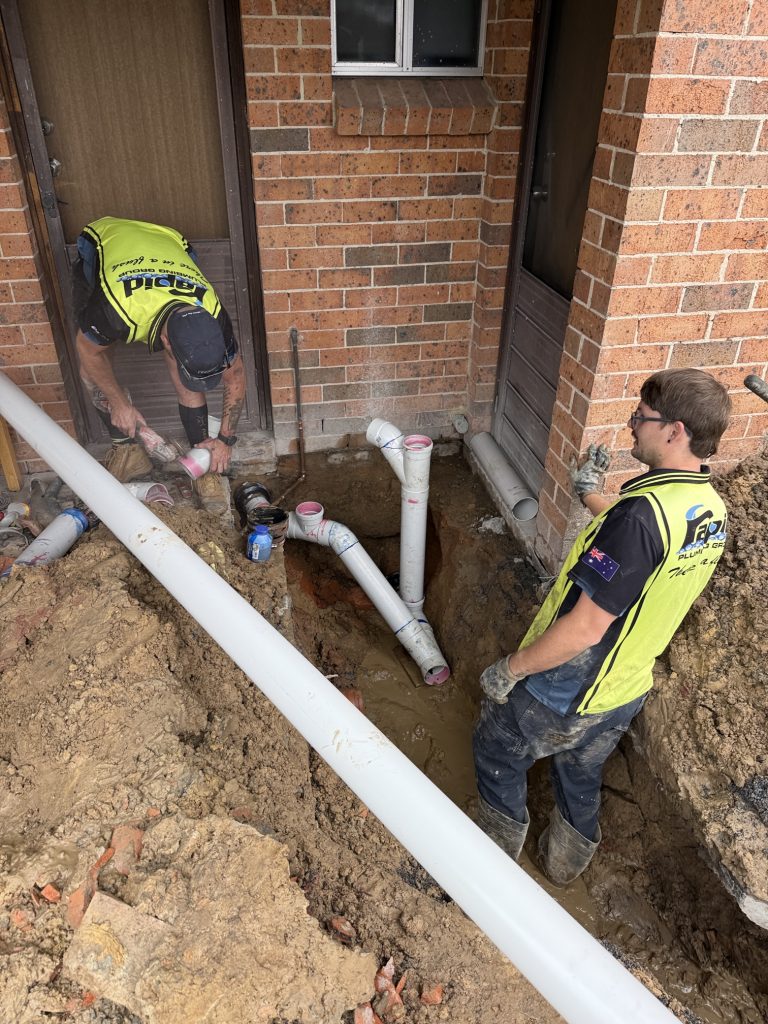
Replacement is the traditional approach and it is still the right one more often than the no-dig marketing suggests. The damaged section is located, the ground above it is excavated, the old pipe comes out, new pipe goes in at the correct fall, and the trench is backfilled and reinstated.
The work itself is not complicated in principle. What makes it a bigger job is everything sitting on top of the pipe. A sewer line under a lawn is one proposition. The same line under a concrete driveway, a pool surround, a retaining wall or the slab of a rear extension is another entirely, because the cost and the disruption move from the plumbing into the reinstatement.
What replacement gives you in return is certainty. You are not repairing an old pipe, you are removing it. Grade can be corrected, undersized sections upsized, poorly made junctions rebuilt, and tired earthenware swapped for modern PVC. If the existing line has problems that a liner would simply follow and preserve, replacement is the only way to actually fix them.
Pipe relining vs pipe replacement in Blacktown, side by side
| Factor | Pipe relining | Pipe replacement |
| Excavation | Usually none, or very limited access points | Trenching along the damaged run |
| Surface impact | Driveways, paving, lawns and trees generally stay intact | Anything above the pipe is lifted and reinstated |
| Time on site | Often completed within a day for a typical residential run | Longer, and longer again if reinstatement is involved |
| Fixes structural collapse | No, the liner needs a host pipe to form against | Yes |
| Fixes incorrect fall or sagging | No, the liner follows the existing shape | Yes, new pipe is laid to correct grade |
| Stops root intrusion at joints | Yes, the lined section becomes jointless | Yes, with modern sealed jointing |
| Changes pipe diameter | Slightly reduces internal diameter, though flow often improves due to the smoother surface | Diameter can be kept or increased |
| Best suited to | Cracked, leaking or root-damaged pipe that still holds its shape | Collapsed, crushed, sagging or badly misaligned pipe |
One line in that table does most of the work. A liner forms against the pipe it is installed into, so it inherits that pipe’s shape and fall. Relining fixes what is wrong with the pipe wall, not what is wrong with the pipe’s position.
When relining is the better fit
Relining tends to be the sensible choice when the diagnosis looks like one of these.
- Root intrusion at joints. Older earthenware lines joined every metre or so give roots a seam to find. Cutting the roots out clears the drain, but the seam remains and they come back. Lining removes the seam.
- Cracks and fractures in a pipe that still holds its round shape. Longitudinal cracks, hairline fractures and small holes are ideal candidates.
- Leaking or displaced joints, common where ground movement has nudged sections apart without breaking them.
- Damage under something expensive, such as a driveway, a slab, a pool surround or established landscaping.
- Recurring blockages in the same spot. If the drain keeps failing at one point, that point has a defect. We covered why a joint or bend is often the real problem separately.
- Tired but continuous older pipework, where the material is deteriorating across a run without having failed structurally.
Root damage in particular is why this conversation happens so often in this part of Sydney. If you are seeing early signs, the warning signs of tree roots in Blacktown drains are worth knowing before the line fails completely.
When replacement is the only honest answer
There are situations where a liner is not a shortcut, it is simply the wrong tool. Any plumber who tells you otherwise is selling rather than diagnosing.
- The pipe has collapsed. If a section has caved in, there is no host pipe left to form the liner against.
- The pipe has sagged, or the fall is wrong. A belly holds water and solids, and a liner will faithfully reproduce it. Only relaying the pipe fixes grade.
- Severe crushing or deformation, where ground pressure or vehicle loading has flattened the pipe out of shape.
- Major misalignment, with sections shifted so far apart they no longer form a continuous path.
- The pipe is undersized. Lining slightly reduces internal diameter, so a line already struggling on capacity needs upsizing instead.
- Multiple serious defects across the full run, where patching a line failing everywhere stops making sense.
The two options are also not mutually exclusive. A very common outcome is a hybrid: excavate and replace one badly failed section, then line the rest of the run. That limits the digging to where it is genuinely needed and is often the most sensible plan on an older Blacktown property.
| Weighing up your options? The most useful next step is not a quote, it is a diagnosis. A CCTV inspection shows the defect, its depth, position and extent, which is what any honest recommendation has to be built on. Our breakdown of what clearing blocked drains in Blacktown costs explains how drainage jobs are usually priced. Talk it through with a plumber in Blacktown before committing to either method. |
Why Blacktown ground makes this decision so common
Drainage problems are not evenly distributed across Sydney, and there are reasons this question comes up so regularly here.
Reactive clay soils. Much of Western Sydney sits on clay that swells when wet and shrinks when dry. Every wet season and dry stretch nudges the ground around a buried pipe, and over decades that movement opens joints, misaligns sections and stresses rigid older materials. It rarely announces itself until a drain starts backing up.
Housing age and pipe material. The established suburbs around Blacktown, Lalor Park, Seven Hills, Doonside and Marayong have plenty of housing stock from the middle of last century, much of it drained in vitrified clay pipe laid in short jointed sections. That material can last a very long time, but every joint is a potential entry point, which is precisely what makes lining so effective on these properties.
Mature trees. Older streets have older trees, and roots go looking for moisture. A hairline crack releasing a small amount of water is all the invitation they need.
Newer estates are not exempt. Homes in The Ponds, Schofields, Marsden Park and Stanhope Gardens are usually on more forgiving PVC, but they see construction damage, poorly bedded pipe settling after backfill, and heavy vehicle loading over shallow runs during the build. Different cause, same decision at the end of it.
Shared and boundary lines. Townhouses, duplexes and villa complexes complicate things, because the defective section may sit on a shared line and the responsibility question has to be sorted out before the repair does. We covered that in our post on shared drainage lines in townhouses and duplexes.
How the decision actually gets made
Nobody should be choosing between these two options from a brochure. The sequence that produces a good decision is short.
- Clear and clean the line. You cannot assess a pipe you cannot see. Jetting removes roots, grease and build-up so the camera has a clear view of the pipe wall.
- Run a CCTV survey. This is the step that decides everything. The camera shows the defect type, its severity, and whether the problem is one bad section or a tired pipe from end to end.
- Locate and depth the defect. A locator marks the position on the surface, which tells you whether replacement means lifting turf or lifting a driveway. That single fact often decides the whole question.
- Ask to see the footage. A reputable plumber will walk you through it. Being quoted for either method without being shown why is a reasonable point to pause.
Some questions worth asking before you sign anything:
- What exactly is wrong with the pipe, and where does the defect start and end?
- Does the line hold its grade, or is there a sag?
- If we reline, what happens at the junctions and are they reinstated?
- If we excavate, what surface has to come up and who reinstates it?
- Is a partial replacement plus lining an option here?
- What warranty applies, and will I get a post-work camera inspection?
If your drainage issue is currently an active overflow rather than a planning exercise, deal with that first. Blocked drain clearing in Blacktown stabilises the situation, and the diagnostic work follows once the line is flowing again.
Key takeaways
- Relining repairs the pipe wall. Replacement repairs the pipe’s position. That is the core difference.
- Relining suits cracks, leaking joints and root intrusion in a pipe that still holds its shape, especially under driveways, slabs and landscaping.
- Replacement is necessary for collapse, sagging, wrong fall, crushing, misalignment and undersized lines.
- Hybrid solutions are common and often the most sensible: dig out the failed section, line the rest.
- Reactive clay, jointed earthenware pipe and mature street trees make this a frequent conversation across Blacktown’s older suburbs.
- No recommendation is credible without a CCTV inspection behind it. Ask to see the footage.
Frequently asked questions
Is pipe relining cheaper than pipe replacement in Blacktown?
It often works out lower overall, but not because the plumbing itself is cheaper. The saving usually comes from reinstatement, since replacement costs include restoring whatever sits above the pipe. Where the line runs shallow under open lawn, straight replacement can be very competitive. The only way to know for your property is to have the defect located and depthed first.
How long does pipe relining last?
Liner manufacturers generally quote design lives measured in decades, and a properly installed liner in a suitable host pipe should be a long-term repair rather than a patch. Real-world longevity depends on how well the pipe was cleaned beforehand, the quality of the cure, and whether the host pipe was a genuine candidate for lining in the first place.
Can any pipe be relined?
No. The pipe needs to be structurally continuous for the liner to form against, so collapsed, crushed or severely deformed sections cannot be lined. Sagging lines and pipes laid at the wrong fall also rule it out, because the liner follows the existing shape and would preserve the problem. This is exactly what a camera inspection is for.
Will relining stop tree roots coming back?
Within the lined section, yes. Roots enter through joints and cracks, and a cured liner removes both along the length it covers. It does not protect pipework outside the lined run, so if only part of the line is treated, roots may still find an entry point further along. Worth clarifying before work starts.
How do I know if my drain problem is structural or just a blockage?
The pattern is the clue. A one-off blockage after wipes, grease or a heavy leaf fall is usually just a blockage. A drain that blocks repeatedly, blocks in the same place, or backs up during rain is generally telling you something structural is going on underground. Repeat failures are the point at which a camera inspection stops being optional.
| Get a straight answer about your pipes. If your drains are backing up, gurgling, or failing in the same spot over and over, the next step is a proper look inside the line rather than another temporary clear. Local Blacktown Plumber services Blacktown and the surrounding suburbs, and can inspect the drain, show you what is there, and explain whether relining or replacement is the right call for your property. Call 02 9158 3589 or get in touch to book an inspection. |